
I Don't Want To Grow Up: Why Play Matters
I woke up this morning singing an old jingle from my childhood:
"I don't want to grow up, I'm a Toys "R" Us kid. There's a million toys at Toys "R" Us that I can play with."
I remember joyfully singing those lyrics on the way to the store with my parents. Toys "R" Us wasn't just a place to shop, it was an experience. I remember buying everything there, from bikes and dolls to science kits that sparked my curiosity and imagination.
Recently, while visiting Macy's in San Antonio, I noticed the statue of Geoffrey the Giraffe, the beloved Toys "R" Us mascot. Families can still sit on the bench and take pictures with Geoffrey, but the display represents only a small fraction of what was once one of the most iconic toy stores in America.
It made me wonder: What happened? More importantly, what are we losing when play becomes less important in our children's lives?
As an early childhood educator, I often hear parents say, "I don't want my child just playing all day."
But perhaps the bigger question is:
What do children miss out on when they don't play?
Imagine this (pun intended): two siblings sitting on the floor. One child has Barbie dolls but no Ken doll. Her brother joins the game, bringing his Ninja Turtle action figure to the pool party she has created using a plastic shoebox. Neither of the toy talks. There are no preprogrammed responses. Together, the children invent their own storyline, creating characters, dialogue, and adventures from their imaginations.
This is the power of pretend play.

Play Builds the Brain
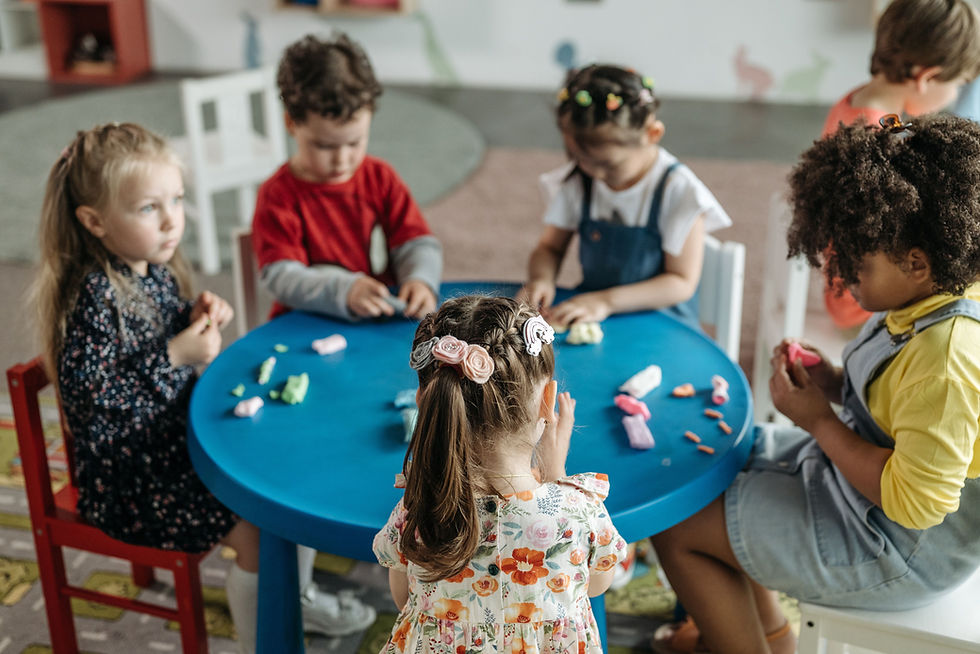
Research shows that play is not wasted time. In fact, the American Academy of Pediatrics describes play as essential for healthy brain development. Through play, children develop cognitive, language, social, and emotional skills that support future academic success.
When children engage in pretend play, they:
Strengthen creativity and imagination.
Practice problem-solving and flexible thinking.
Develop language and communication skills.
Learn to negotiate, cooperate, and share.
Explore emotions and practice empathy.
Social and Emotional Learning Happens Naturally
Pretend play gives children opportunities to act out both positive and negative experiences in a safe environment. A child may become the teacher, doctor, parent, superhero, or even the villain. Through these roles, children process real life events and experiment with different ways to solve problems.
Researchers have found that dramatic play supports self-regulation, which is the ability to manage emotions, control impulses, and persist through challenges. These skills are strong predictors of later success in school and life.
Language Flourishes Through Conversation
Unlike electronic toys that do the talking, traditional toys encourage children to create their own conversations and stories.
When children play with siblings or peers, they practice:
Taking turns in conversation.
Using new vocabulary.
Asking questions.
Explaining ideas.
Listening to others.
These experiences lay the foundation for literacy and communication skills.
Toys Don't Need Batteries to Be Powerful
Some of the most meaningful learning comes from simple, open-ended materials:
Dolls and action figures
Blocks and building sets
Dress-up clothes
Play kitchens
Cardboard boxes
Art supplies
These materials invite children to think, create, and imagine rather than simply press buttons.
Protecting Childhood
Perhaps Geoffrey the Giraffe reminds us of something larger than a beloved toy store. He reminds us that childhood should include wonder, creativity, and the freedom to play.
Play is not a break from learning.
A Summer Challenge for Parents
This summer, I challenge parents to do one simple thing at least once each week: turn off the television, put away the tablets and video games, and unplug from electronic devices.
Instead, encourage your children to play a game or better yet, create one of their own. Give them opportunities to use their imagination, solve problems, negotiate rules, and think critically. Whether they are building forts, inventing stories, or creating a backyard obstacle course, they are developing analytical and critical thinking skills that no app or screen can replace.
Childhood is short. Let's protect the joy, creativity, and wonder that come from play.
Because sometimes the greatest learning happens when children are simply allowed to be kids.
References
American Academy of Pediatrics. (2018). The Power of Play: A Pediatric Role in Enhancing Development in Young Children.
Center on the Developing Child at Harvard University. Serve and Return Interaction Shapes Brain Architecture.
Bodrova, E., & Leong, D. (2007). Tools of the Mind: The Vygotskian Approach to Early Childhood Education.
National Association for the Education of Young Children (NAEYC). Developmentally Appropriate Practice Position Statement.


Great article! With the hustle and bustle of everyday ife, we as parents/caregivers tend to forget out the experences we had we were playing outdoors or even making up games in the house during raining days.
Something as simple as playing a game with others can strengthen even the youngest child Social-Emotional skills, which in returns lead to being a Team player in the workplace.
Thanks for the reminder and the encouragement to getting back to basics!
Great article! So often todays parents use electronics and digital devices to not only entertain our children but to teach them as well. And though those options are useful they can not replace the power of creative play and human interactions. To allow our children the time to “play” requires parents to slow down and disconnect as well. Our children are watching.
This article has inspired me to remain childlike, creative and curious and most importantly to disconnect and make time for more human interactions.
The title of this article immediately got my attention, I don’t wanna… took me back a few years when my two daughters were at that age where I can yet hear them repeatedly saying, “I don’t wanna”, and though I cringed then when it came to television, Sesame Street’s Geoffrey seemed to get and hold my daughters creative attention allowing me to focuse on other needs.
This article not only emphasizes the spiritual development that playing develops in children, it also highlights the importance of recreating the space and fostering the opportunities that allow our youths minds to naturally develop socially, mentally and mentally. This article also provides a clear organic path for the family, the community and the worl…
I loved everything about this article!!
I found this very enlightening